

Learn Intarsia and Bobble Stitch with Free Practice Squares
Intarsia colourwork and bobble stitch can feel like a big step when you first meet them in a full baby blanket pattern. This free knitting practice pattern gives you a smaller, manageable way to learn both techniques and build your confidence before beginning a larger project.
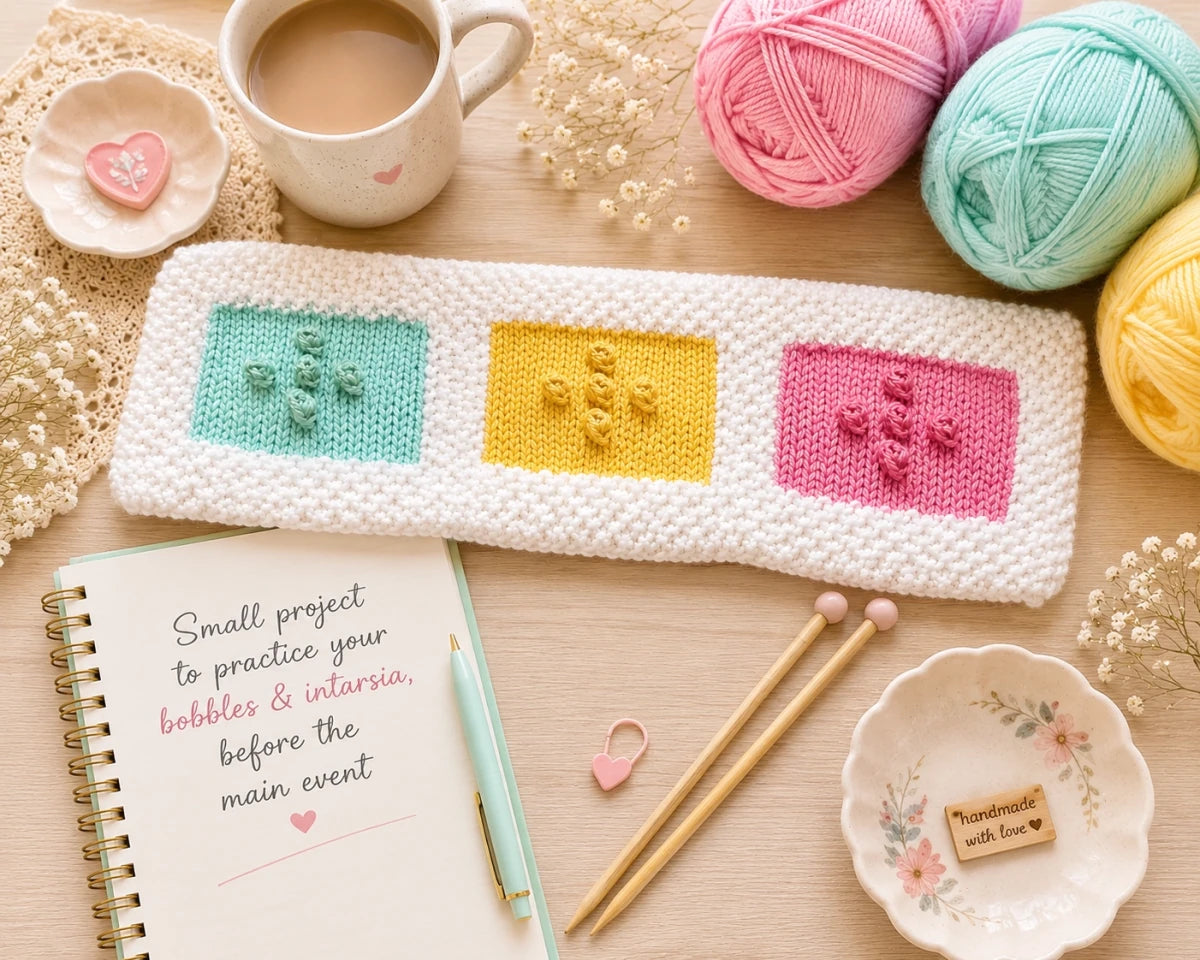
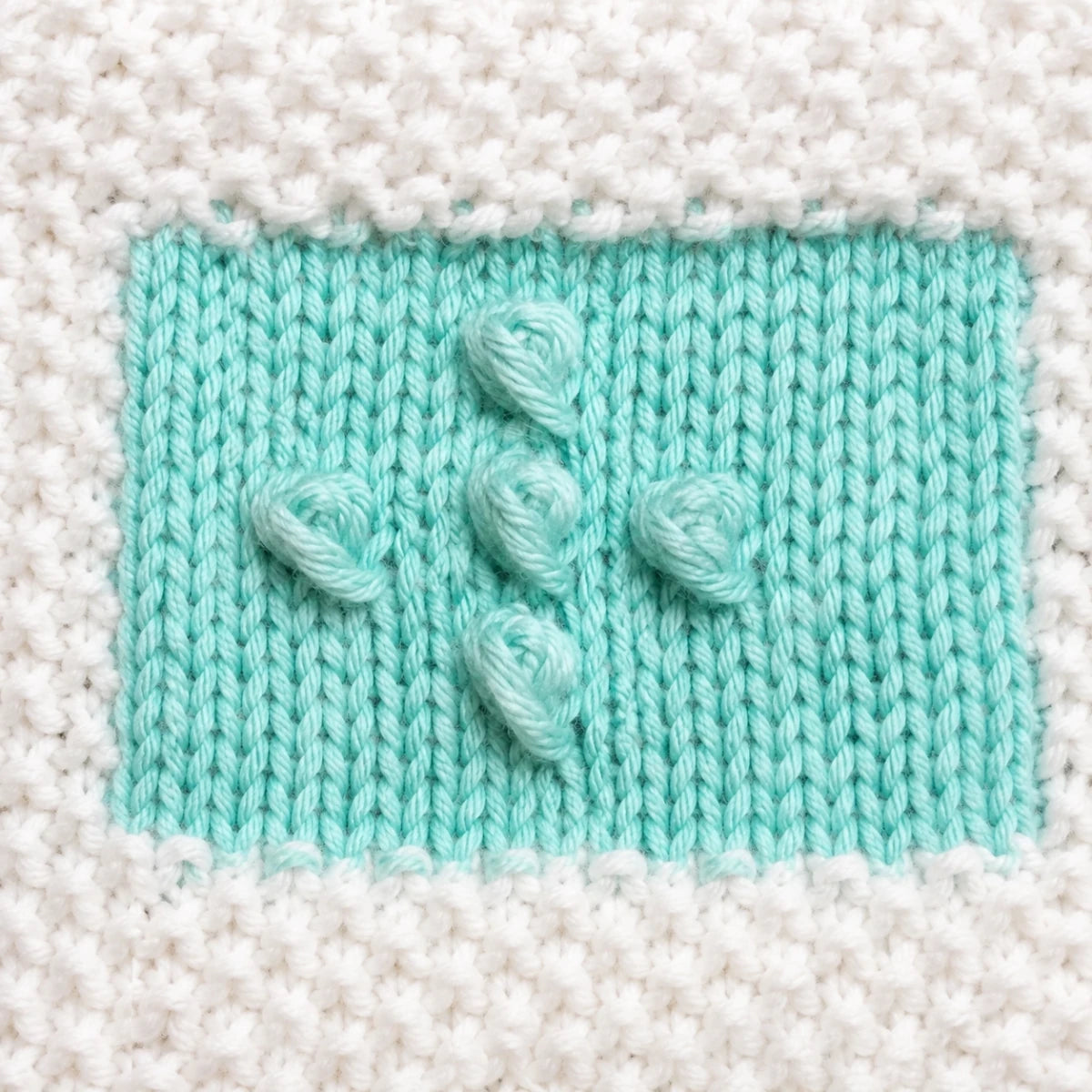
Worked flat in one piece, the sample features three pastel intarsia squares surrounded by a neat seed stitch border. Raised bobbles add texture within each square, giving you the opportunity to practise colour changes, yarn management and bobble placement in one satisfying project.
This is an Advanced Beginner knitting pattern. You should already be comfortable with basic knit and purl stitches, but you do not need previous intarsia or bobble-stitch experience.
Download the free printable PDF →
The printable PDF includes the complete written pattern, a main knitting chart, an intarsia colour chart and step-by-step bobble stitch photographs. No payment is required.
What You Will Practise
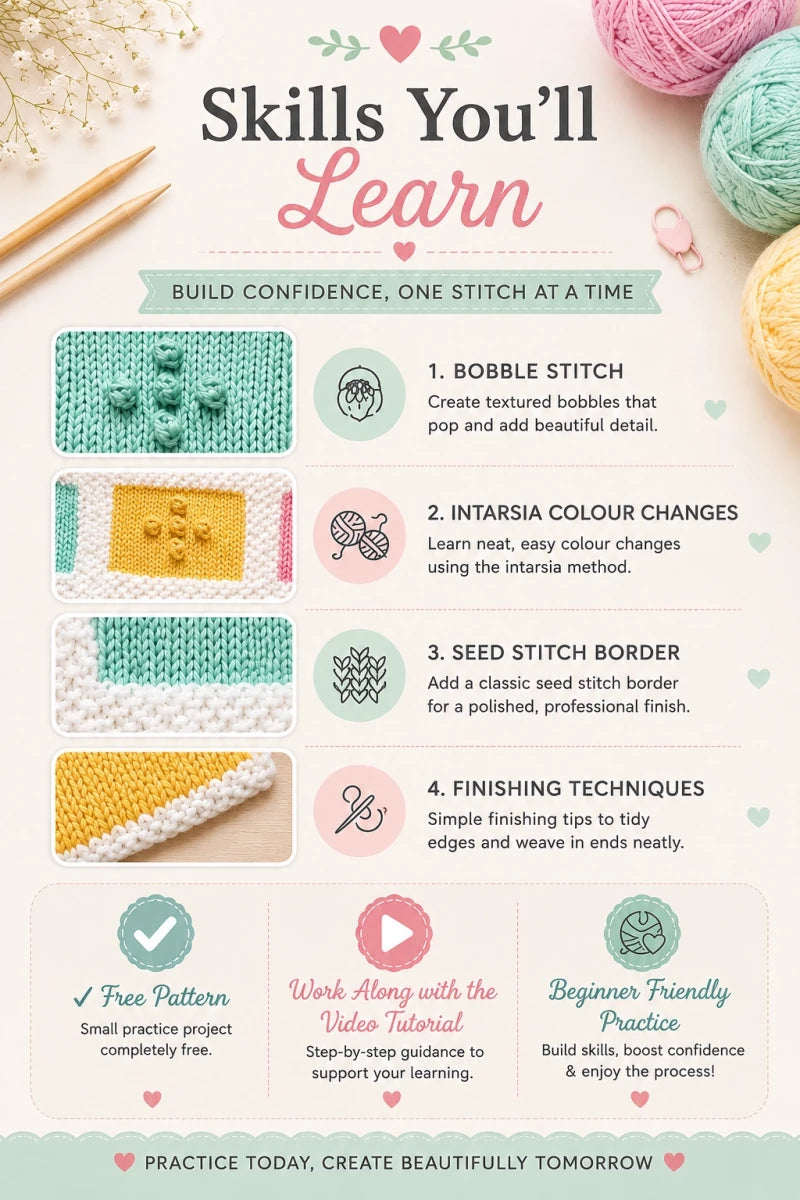
- Intarsia colour changes
- Managing separate sections of yarn
- Creating raised bobble stitches
- Following written row-by-row instructions
- Reading knitting and colourwork charts
- Working a seed stitch border
- Maintaining even tension across colour changes
Free Intarsia Practice Pattern at a Glance
- Skill level: Advanced Beginner
- Construction: Worked flat in one piece
- Finished size: Approximately 5 × 17 inches (13 × 43cm)
- Gauge: 18 stitches × 24 rows = 4 × 4 inches (10 × 10cm)
- Needles: 5mm knitting needles (US 8 / UK 6)
- Yarn weight: Aran / worsted-weight yarn
- Techniques: Knit, purl, seed stitch, bobble stitch and intarsia colourwork
- Stitch count: Every row contains 79 stitches
Materials
- Small amounts of Aran / worsted-weight yarn in four solid colours
- 5mm knitting needles (US 8 / UK 6)
- Tapestry needle
- Scissors
The original sample was knitted using Caron Simply Soft yarn with white for the border and separating sections, plus mint green, yellow and pink for the three intarsia squares. You can choose any four solid colours you love.
Before You Begin
- The complete sample is knitted flat in one piece; the three coloured squares are not made separately or sewn into the border.
- Every row contains 79 stitches. Count your stitches regularly so that the intarsia sections remain correctly positioned.
- For the clearest result, use plain solid-colour yarn rather than striped or variegated yarn.
- The right side is the front of the work, where the bobbles will be displayed.
- The intarsia colour changes begin on Row 8 and finish after Row 24.
- Change needle size if necessary to achieve the stated gauge.
Video Tutorial Support
If you prefer to learn visually, follow the Bobble Stitch Blankets video tutorial. This detailed video uses the Intarsia Sample Squares pattern to demonstrate setting up the colour sections and working Rows 8, 9 and 10. It also includes bobble-stitch guidance, yarn-management tips and help correcting mistakes.
Helpful Video Timings
- 00:48 – Creating a bobble stitch
- 06:03 – Unpicking a bobble stitch
- 13:00 – Setting up the intarsia yarn
- 17:58 – Working Row 8 of the practice pattern
- 26:00 – Preventing tangled intarsia yarn
- 28:08 – Continuing with Row 9
- 35:04 – Working Row 10 and the even-row sequence
- 40:37 – Weaving in the yarn ends
- 43:37 – Adding a missing bobble or removing a misplaced bobble
Watch the knitting video tutorial →
Knitting Abbreviations
- k – Knit
- p – Purl
- mb – Make bobble
- sts – Stitches
- rs – Right side of work
- ws – Wrong side of work
- ( ) – Work the stitches within the brackets the number of times specified
Yarn Colour Abbreviations
- CG – Green yarn
- CP – Pink yarn
- CW – White yarn
- CY – Yellow yarn
Need a reminder of the basic stitches? Visit the knit stitch tutorial, purl stitch tutorial or bobble stitch tutorial.
Free Intarsia and Bobble Stitch Practice Knitting Pattern
Lower Seed Stitch Border
Using CW, cast on 79 sts.
Rows 1–7:k1, (p1, k1) 39 times. (Seed stitch)
Intarsia Squares
Begin the intarsia colour changes on Row 8 and continue through Row 24. During these rows, the colour sections are worked in a different order depending on whether you are knitting a right-side or wrong-side row. This is because you are viewing the coloured squares from opposite directions as the work is turned.
Even Rows 8–24
CW 6 sts, CG 19 sts, CW 5 sts, CY 19 sts, CW 5 sts, CP 19 sts, CW 6 sts.
Odd Rows 9–23
CW 6 sts, CP 19 sts, CW 5 sts, CY 19 sts, CW 5 sts, CG 19 sts, CW 6 sts.
Keep each yarn section organised as you work and follow the colour order carefully at every change. The free PDF contains an intarsia colour chart if you prefer a visual guide.
Row 8:k1, (p1, k1) 39 times. (Seed stitch) (ws)
Row 9:(k1, p1) 3 times, *k19, (p1, k1) 2 times, p1** – repeat from * to ** 2 more times, k in last st.
Rows 10, 12, 14, 16, 18, 20, 22 and 24: (k1, p1) 2 times, k1, (p21, k1, p1, k1) 3 times, p1, k1.
Row 11:(k1, p1) 3 times, *k19, (p1, k1) 2 times, p1** – repeat from * to ** 2 more times, k in last st.
Row 13:(k1, p1) 3 times, *k9, mb, k9, (p1, k1) 2 times, p1** – repeat from * to ** 2 more times, k in last st. (3 bobbles)
Row 15:(k1, p1) 3 times, *k19, (p1, k1) 2 times, p1** – repeat from * to ** 2 more times, k in last st.
Row 17:(k1, p1) 3 times, *k5, (mb, k3) 2 times, mb, k5, (p1, k1) 2 times, p1** – repeat from * to ** 2 more times, k in last st. (9 bobbles)
Row 19:(k1, p1) 3 times, *k19, (p1, k1) 2 times, p1** – repeat from * to ** 2 more times, k in last st.
Row 21:(k1, p1) 3 times, *k9, mb, k9, (p1, k1) 2 times, p1** – repeat from * to ** 2 more times, k in last st. (3 bobbles)
Row 23:(k1, p1) 3 times, *k19, (p1, k1) 2 times, p1** – repeat from * to ** 2 more times, k in last st.
Upper Seed Stitch Border
From Row 25, continue using CW only.
Row 25:(k1, p1) 3 times, *k19, (p1, k1) 2 times, p1** – repeat from * to ** 2 more times, k in last st.
Rows 26–33:k1, (p1, k1) 39 times. (Seed stitch)
Cast off in seed stitch.
Finishing Your Practice Sample
Secure the yarn ends neatly on the wrong side of the work. Gently shape the sample to the finished measurements, taking care not to flatten the raised bobbles.
Well done—you have completed your intarsia and bobble stitch practice project and are ready to use these skills in a larger design.
Get the free PDF knitting pattern →
What to Knit Next
Ready to turn your new skills into a baby blanket? These patterns use intarsia colourwork, bobble stitch or both:
- Heart Squares Baby Blanket Knitting Pattern
- Number Squares Baby Blanket Knitting Pattern
- Sweet Dreams Baby Blanket Knitting Pattern
- Twinkle Twinkle Little Star Baby Blanket Knitting Pattern
- Free Cancer Support Lap Blanket Knitting Pattern
For more inspiration, explore our guide to modern baby blanket knitting patterns, or browse all intarsia knitting patterns, bobble stitch knitting patterns and practice knitting patterns.
Frequently Asked Questions
Is this intarsia knitting pattern suitable for beginners?
The pattern is designed for Advanced Beginner knitters. You should be comfortable with knit and purl stitches, but the small format, written instructions, charts and video support make it a gentle first intarsia and bobble-stitch project.
Is the sample worked flat?
Yes. The complete sample is knitted flat in one piece on straight knitting needles. The three coloured squares form part of the main knitting and are not sewn on afterwards.
Can I use different colours?
Yes. You can replace the mint, yellow and pink with any solid colours you prefer. Using four clearly contrasting colours will make the intarsia sections and seed stitch border easy to see.
Does the free PDF include knitting charts?
Yes. The free printable PDF contains a main knitting chart, a separate intarsia colour chart, written row-by-row instructions and step-by-step bobble stitch photographs.
Why should I practise before knitting a blanket?
A smaller practice project lets you become comfortable with colour changes, bobble placement and yarn tension without the time or yarn commitment of a full blanket. You can repeat the sample until the techniques feel natural.
Can I sell items made from this pattern?
Yes. Finished items may be sold when the pattern is credited to Peach Unicorn Designs. The written pattern, charts and photographs may not be copied, shared, resold, translated for resale or redistributed.
Pattern Copyright
This knitting pattern, its charts and photographs are protected by UK copyright law. The pattern is provided for personal use and may not be reproduced or distributed without permission. Permission is granted to sell finished handmade items when Peach Unicorn Designs is credited as the pattern designer.
Let’s make something beautiful together.